
How to Get Through the "Ugly Stage" of Painting
Recently, a student of mine shared a photo of her painting and asked:
“Where did I go wrong? And how do I fix it?”
Questions like these mean I get to play art detective. I spot what’s working, what’s not, and then map out a solution.
In this case, my answer to her was actually the same answer I give to most painting problems I hear about.
Her painting was off to a fabulous start. All she needed were a few finishing touches:
More contrast to help the highlights and shadows pop
Deeper layering to build dimension and bring out the forms
Refined finishing details and small additions that make a big visual impact
I hear this all the time from students:
“My painting looks flat.”
“I’m stuck in the ugly stage.”
"I don't know where I've gone wrong."
Have you felt that way? You're not the only one!
Let's talk about the "ugly stage." That phrase is a little bit negative, but I get what they mean. If you’ve ever tried to paint, you recognize that ugly stage when you’re there.
But what I’d love for you to know is…
...the ugly stage just means your painting isn’t finished yet.
Watercolor takes patience and layering. The difference between almost finished and fully finished is often dramatic, and when you see it, you feel it.
Let me show you what I mean.
Here’s a Magnolia Branch tutorial from inside my botanical watercolor membership, The Garden Studio.
Below, you’ll see progress photos as I build up the painting layer by layer. At any of these earlier stages, I could’ve stopped... but the painting wouldn’t have the same richness or clarity.
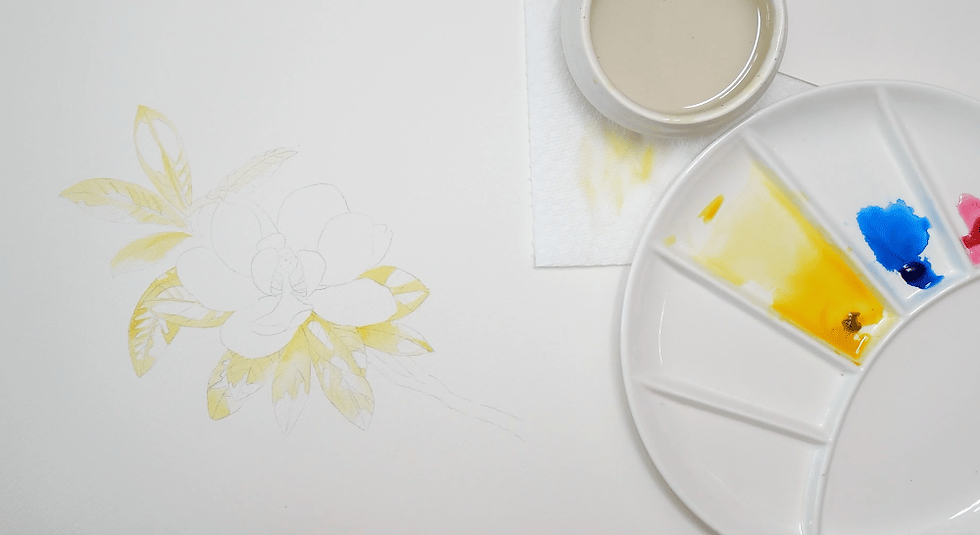


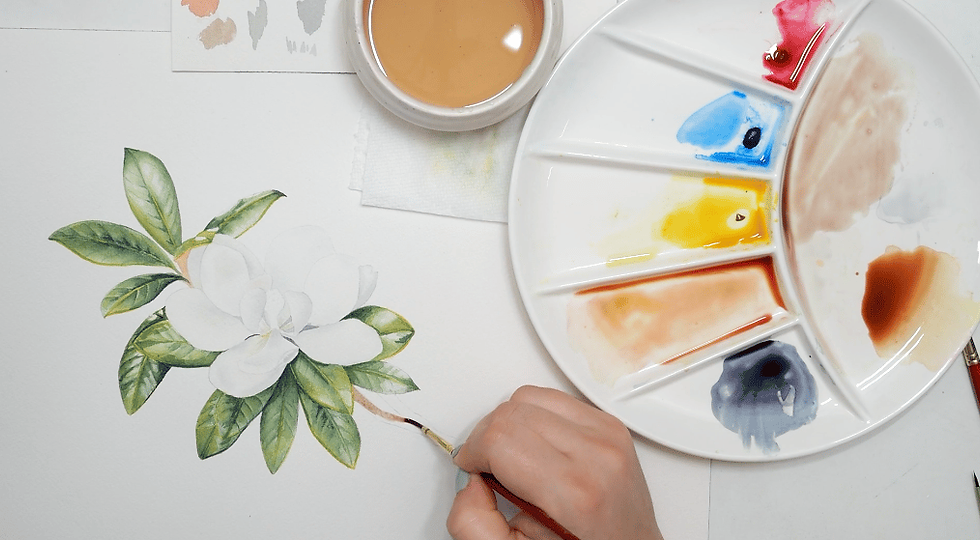

And here is the finished painting:

What makes it feel “done”?
It comes down to contrast, layering, and detail. Specifically:
High contrast between the lightest petals and the darkest greens
Strategic placement like setting white petals against dark foliage for drama and clarity
Adding in different textures like rough stems, glossy leaves, smooth petal transitions
Does that feel a little overwhelming to you? If so, that is completely normal.
It’s also exactly why I teach the way I do.
In this Magnolia Branch tutorial inside my membership, The Garden Studio, I walk students through every part of the process:
Mixing all the colors from just three primary paints (yup, we only used three paints for this whole project)
Creating soft, realistic blends with wet-into-wet
Painting convincing white flowers without using white paint
Building layers for depth and realism
Adding small details that elevate the entire piece
Watercolor doesn’t require perfection. You just need practice, patience, and the right guidance (hi, I’m here for you! 🙋🏻♀️ )
I truly believe that if you want to paint beautiful, advanced compositions like this, you can. It just takes time and the right teaching to get there.
If you want to learn to paint beautiful botanicals, join the waitlist for The Garden Studio!
And in the meantime, check out my watercolor tutorials on YouTube!

Comments